Exploring Industrial Chillers: A Guide on Chillers for Homes, Buildings, and Industry
Industrial chillers play a crucial role in modern residential, commercial, and industrial settings, offering essential solutions for temperature control and energy efficiency. Understanding how these systems function, their applications, and their benefits can be beneficial for homeowners, building managers, and industry professionals alike.
At their core, chillers are machines designed to remove heat from a liquid via a vapor-compression or absorption refrigeration cycle. This chilled liquid can then be circulated through a heat exchanger to cool air or equipment as required, making chillers integral to air conditioning systems, refrigeration processes, and various industrial applications. These systems can be classified into two main types: air-cooled and water-cooled. Air-cooled chillers utilize air to dissipate heat and are typically favored for locations with water scarcity or where environmental impacts must be minimized. Conversely, water-cooled chillers employ water in conjunction with a cooling tower, offering greater efficiency, particularly in larger-scale operations where they can dissipate heat more effectively.
The adoption of chillers in residential homes is becoming increasingly prevalent, particularly in regions that experience extreme temperatures. Homeowners seeking efficient and reliable cooling solutions may benefit from small-scale air-cooled chillers. These smaller systems often prove to be a cost-effective and sustainable option, helping regulate indoor temperatures and improving overall comfort levels with reduced energy consumption compared to traditional HVAC systems. Moreover, advancements in chiller technology have enabled the development of smaller, quieter units suitable for home use, enhancing their appeal for residential applications.
In commercial buildings, chillers are commonly integrated into centralized cooling systems to maintain a comfortable indoor climate for occupants. Office buildings, shopping malls, hotels, and hospitals often rely on air or water-cooled chillers to regulate temperatures efficiently. Selecting the right type of chiller for a commercial building depends on several factors, including the building's size, architectural design, cooling load requirements, and energy considerations. Many commercial systems also benefit from chiller plants, which combine multiple chillers in a single system, utilizing advanced control strategies to enhance efficiency and reliability.
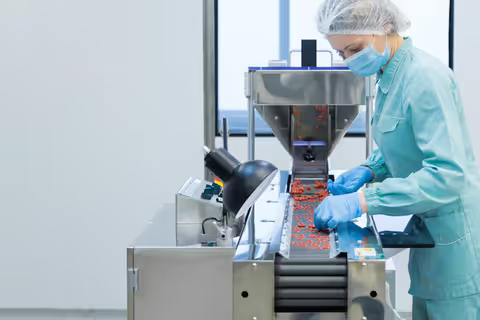
Industrial applications of chillers are diverse and wide-ranging, supporting processes across multiple sectors, including manufacturing, agriculture, pharmaceuticals, and food and beverage production. In these environments, maintaining precise temperature control is often critical to ensuring product quality and process efficiency. For example, in the plastics industry, chillers help regulate the temperature of molds to ensure high-quality product output. In the food and beverage industry, chillers are integral to preserving the freshness and safety of perishable goods through consistent temperature management.
Chiller efficiency and operation often hinge on various technical specifications and components that merit consideration. Key factors include the system's coefficient of performance (COP), which indicates the efficiency of heat removal compared to energy consumed, and the type of refrigerant used, which can impact both performance and environmental footprint. Modern chillers increasingly utilize environmentally friendly refrigerants, aligning with global efforts to reduce greenhouse gas emissions and the carbon footprint of cooling technologies.
Maintenance and operational considerations are paramount to maximizing chiller performance and lifespan. Regular maintenance can include cleaning heat exchangers, checking refrigerant levels, inspecting compressor performance, and ensuring the cleanliness of cooling towers in water-cooled systems. Many chiller systems now incorporate smart technology and remote monitoring capabilities, allowing for predictive maintenance practices that can preemptively identify and address potential issues before they become critical.
The economic implications of choosing appropriate chiller systems cannot be understated. Investing in systems with advanced technology features, such as variable speed drives or magnetic bearing compressors, can yield significant energy savings and reduce operational costs over time. Additionally, adopting energy-efficient chillers may provide eligibility for government incentives and rebates aimed at promoting sustainable practices within both residential and industrial settings.
As concern for sustainable energy practices grows, the future of chiller technology promises continued innovation, aiming to balance efficiency, environmental responsibility, and cost-effectiveness. Future developments may include enhanced integration with renewable energy sources, further improvements in system controls, and the increased use of data analytics to optimize performance.
In conclusion, the multifaceted nature of chillers makes them indispensable across various sectors. Whether employed in residential, commercial, or industrial settings, understanding their operation, maintenance, and application can inform decisions that improve comfort, efficiency, and sustainability. As technology advances, continued exploration and education on chiller systems will undoubtedly yield further enhancements, benefiting homeowners, businesses, and industries worldwide.