How Industrial Conveyor Systems Support Efficient Manufacturing Processes
Industrial conveyor systems are mechanical equipment designed to transport materials and products from one point to another within a production facility. These systems exist to automate the movement of goods, reducing the need for manual handling and ensuring a continuous, efficient workflow
The fundamental purpose of a conveyor is to streamline operations. They provide a reliable method for moving items through various stages of production, from raw material intake to assembly, packaging, and final distribution. This technology has become a cornerstone of modern manufacturing because it addresses the basic need for efficient material flow, which is essential for any large-scale production environment .
Why Conveyor Technology is Essential Today
Industrial conveyor systems are crucial because they directly address key challenges in modern manufacturing, such as the need for speed, consistency, and safety. This technology affects a wide range of industries, including automotive, electronics, food and beverage, and logistics, helping to solve problems related to production bottlenecks and workplace injuries .
| Challenge | How Conveyor Systems Provide a Solution |
|---|---|
| Production Bottlenecks | Automate transport to keep products moving, reducing idle time between workstations . |
| Manual Labor Demands | Reduce the need for heavy lifting and repetitive tasks, allowing workers to focus on higher-value activities . |
| Quality Consistency | Provide a stable and repeatable flow, minimizing errors that can occur with manual handling . |
| Workplace Safety | Lower the risk of injuries from lifting and repetitive motions. They also include built-in safety features like emergency stops and guards . |
| Scalability | Modular designs allow for easy expansion or reconfiguration to meet changing production demands . |
By automating material transport, conveyors help optimize production lines, improve consistency, and create a safer work environment . Their ability to integrate with other automated systems makes them a critical component of the modern "smart factory" .
Recent Updates in Conveyor System Technology
The past year has seen a significant shift from simple transport systems to intelligent, data-driven solutions. A major trend is the integration of the Internet of Things (IoT) and artificial intelligence (AI) to create "smart conveyance" systems .
A notable development is the move toward systems that can think and adapt. As of late 2025, modern conveyors are being designed with sensors for real-time monitoring, predictive maintenance capabilities, and adaptive control that adjusts speed and routing based on production demands . According to industry analysis, the global conveyor system market was valued at USD 8.7 billion in 2025 and is projected to grow significantly, driven by the adoption of these advanced technologies .
Industry reports from early 2025 highlight the increasing use of linear motor technology in conveyor design, allowing for faster speeds and more precise control compared to traditional systems . This shift is enabling more flexible and efficient production workflows, particularly in automated environments where robotics play a key role . For instance, in January 2025, the merger of companies specializing in material processing and automated handling solutions indicates a trend toward providing integrated, comprehensive systems .
Regulatory Framework and Safety Standards
The use of industrial conveyor systems is subject to regulations and standards to ensure the safety of workers and the reliability of operations. In India, the Bureau of Indian Standards (BIS) plays a key role in establishing these guidelines .
For example, a revised standard for screw conveyors, IS 5563:2024, was published, providing updated specifications for their industrial use . Furthermore, a code of practice for the selection and design of belt conveyors, IS 11592:2000, was reaffirmed in August 2025, confirming its continued validity as a guiding document for industry professionals . These standards, overseen by committees like MED 6 (Continuous Bulk Conveying, Elevating, Hoisting Aerial Ropeways and Related Equipment), are designed to ensure that equipment is manufactured and used safely, with specific guidelines on design, operation, and maintenance . As automation increases, future compliance frameworks are expected to evolve to address the safe interaction between humans and machines .
Tools and Resources
Various resources are available to help understand and implement industrial conveyor systems effectively.
Technical Standards: Access to standards published by organizations like the Bureau of Indian Standards (BIS) provides essential guidelines for design, selection, and safety.
Reference Books: Publications such as Conveyors: Application, Selection, and Integration by Patrick M. McGuire (2nd Edition, 2024) offer comprehensive insights into the various types of conveyors and their integration into production systems .
Industry Reports: Market research reports, like the Global Conveyors System Market Report published in 2025, provide data on trends, growth forecasts, and technological advancements in the field .
Educational Content: Manufacturers and industry groups often provide application notes, guides, and eLearning modules that illustrate how conveyor systems are used across different sectors.
Frequently Asked Questions
1. What are the most common types of industrial conveyor systems?
Common types include belt conveyors, ideal for packaging and assembly lines; roller conveyors, used for cartons and pallets; flexible chain systems, which can navigate curves and tight spaces; and overhead conveyors, which maximize floor space . The choice depends on the product type and the facility layout.
2. How do smart conveyor systems improve manufacturing?
Smart conveyors use sensors and IoT connectivity to monitor speed, flow, and system health in real-time . They can alert operators to potential failures before they happen (predictive maintenance) and automatically adjust operations to prevent bottlenecks, thereby improving overall efficiency and reducing downtime .
3. What is the role of conveyor systems in workplace safety?
Conveyors enhance safety by reducing the need for manual lifting and carrying, which lowers the risk of musculoskeletal injuries . They are also equipped with safety features like emergency stops, guardrails, and sensor-based systems that can detect jams and automatically halt operations to prevent accidents .
4. How are conveyor systems integrated with robotics?
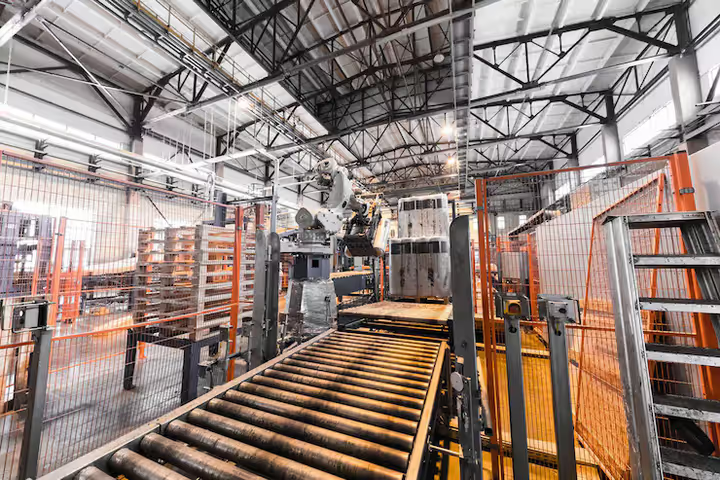
Conveyors serve as the "connective tissue" for robotic systems in manufacturing . They ensure that products are delivered to a robot's workspace in a predictable manner, enabling precise picking, placing, or assembly. Coordinated motion between the conveyor and robotic arms allows processes to continue efficiently within a work cell .
5. What are the key trends in conveyor technology for 2025 and beyond?
Key trends include the integration of AI and IoT for smarter operations, the use of energy-efficient and eco-friendly materials, the development of modular systems for greater flexibility, and the adoption of advanced propulsion technologies like linear motors for higher speeds and precision .
Conclusion
Industrial conveyor systems have evolved from simple transport mechanisms to intelligent, data-driven assets that are fundamental to modern manufacturing. They solve critical challenges related to efficiency, safety, and scalability across a wide range of industries. The latest trends, including the integration of IoT and AI, are making these systems smarter and more adaptive. As regulatory standards continue to ensure their safe operation, conveyors will remain a vital component in the drive toward more automated, efficient, and sustainable production processes.